


Brakes are one of the most important safety features of any vehicle. They are responsible for slowing down or stopping a moving vehicle. They are also crucial for ensuring the safety of the driver, passengers, and other road users. Whether you’re driving a regular car or a high-performance vehicle, the type of brakes you choose can have a significant impact on your driving experience and safety.
In this blog, we will compare performance brakes and regular brakes, exploring their differences, advantages, and disadvantages.
What Are Performance Brakes?
Performance brakes, also known as high-performance brakes, are designed for vehicles that demand higher braking capabilities. These brakes are typically found in sports cars, luxury vehicles, and high-performance aftermarket applications. They are engineered to withstand more heat and provide better stopping power and control, especially during high-speed or aggressive driving.
The Upsides of Performance Brakes
Heat Dissipation
Performance brakes are designed to handle higher temperatures, making them less prone to brake fade during aggressive driving or heavy braking situations.
Stopping Power
Performance brakes provide better stopping power and shorter stopping distances, which can be critical in emergencies and high-speed driving.
Also Read: Role of Emergency Brake in Emergency Situation
Enhanced Control
These brakes offer improved pedal feel and modulation, allowing for better control and precision in braking.
Resistance to Brake Fade
Performance brakes are less likely to experience brake fade, maintaining consistent performance even under extreme conditions.
The Downsides of Performance Brakes
Cost
Performance brakes are typically more expensive due to their advanced materials and engineering.
Also Read: Difference Between Cheap And Expensive Brake Pads
Noisier Operation
Some performance brake systems may generate more noise during normal driving conditions.
Harder on Rotors
Their aggressive braking capabilities can lead to faster wear on rotors and brake pads, which may increase maintenance costs in the long run.
What Are Regular Brakes?
Regular brakes, also known as stock or standard brakes, are the default braking systems found in most factory-made vehicles. While they are not specifically designed for performance or high-speed driving, they are developed to meet the braking needs of everyday driving situations.
The Upsides of Regular Brakes
Cost-Effectiveness
Regular brakes are less expensive to maintain and replace, making them more budget-friendly for everyday drivers.
Quiet Operation
They generally produce less noise during normal driving, providing a smoother and quieter driving experience.
Longevity
Regular brake systems are designed for durability and can effectively handle typical driving needs without excessive wear.
The Downsides of Regular Brakes
Heat Limitations
Regular brakes may experience reduced performance and brake fade in high-temperature conditions, such as during prolonged or aggressive braking.
Limited Stopping Power
They may not offer the same level of stopping power and control as performance brakes, especially during high-speed or demanding driving scenarios.
Subpar Modulation
Some regular brake systems may lack the precise pedal feel and modulation offered by performance brakes, impacting the driver’s ability to control the braking force.
Comparing the Two
Performance brakes and regular brakes cater to different driving needs, and their differences should be considered based on the driving habits and expectations of the vehicle owner. Performance brakes shine in high-performance applications, such as track driving or aggressive street driving, where superior braking capabilities are essential. On the other hand, regular brakes are well-suited for everyday commuting and routine driving scenarios, offering a balance of cost-effectiveness and reliability.
When choosing between performance brakes and regular brakes for their vehicles, drivers should consider several key factors to make an informed decision.
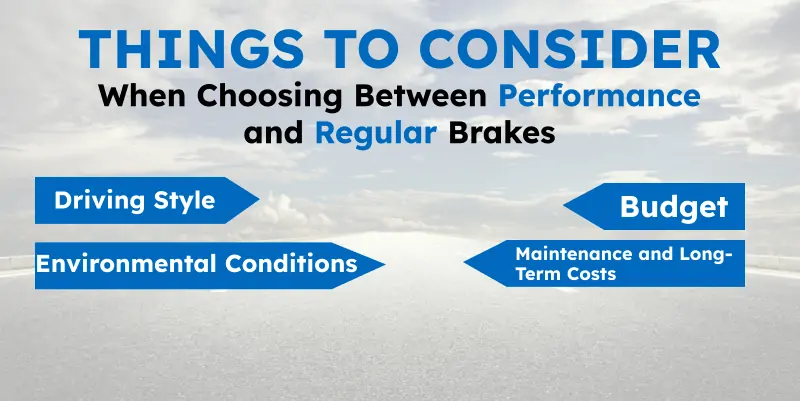
Driving Style
Drivers should evaluate their typical driving style and conditions. If they engage in high-speed driving, track events, or aggressive driving, performance brakes may be a better choice to provide the necessary stopping power and heat resistance. On the other hand, for daily commuting and normal driving, regular brakes may suffice.
Budget
Performance brakes are typically more expensive due to their advanced engineering and materials. Drivers should assess their budget and willingness to invest in higher-quality braking systems versus staying within a more modest budget with regular brakes.
Maintenance and Long-Term Costs
Performance brakes may require more frequent maintenance and have higher replacement costs for brake pads and rotors. Drivers should consider the long-term costs associated with each type of brake system, including upkeep and part replacements.
Environmental Conditions
Consideration should be given to the environmental conditions in which the vehicle will be driven. Performance brakes are better suited for handling heat and heavy braking, making them ideal for hot climates or steep terrains. Regular brakes may struggle in these conditions, potentially leading to brake fade and reduced performance.
Conclusion
The choice between performance brakes and regular brakes ultimately depends on the driver’s preferences, driving habits, and the intended use of the vehicle. While performance brakes deliver exceptional stopping power, heat resistance, and control, they come with a higher price tag and potentially increased maintenance costs. Regular brakes, while more budget-friendly and adequate for everyday driving, may need more robustness and precision for high-performance applications. Drivers need to weigh these factors and make an informed decision about which type of brake system best suits their needs and driving style.
By understanding the differences between performance brakes and regular brakes, drivers can make well-informed choices to ensure both safety and performance in their driving experiences.
People Also Ask
Do performance brakes make a difference?
Swapping in performance street pads helps maintain braking strength at higher temperatures than factory-style pads. In general, because performance pads have a more metallic compound, they might wear rotors a tad faster and produce more dust, but they’re a great upgrade over OEM for sure.
Are performance brakes good for daily driving?
Upgrading to quality entry-level performance brake pads often does the trick for daily drivers. If you go with a quality brand, you’ll notice some improvements in your vehicle’s braking performance.
What is the difference between brake pads and performance brake pads?
Performance Street pads are a step up from most Original Equipment and Premium replacement pads in the areas of pedal sensitivity, ultimate stopping power and improved resistance to fade caused by high operating temperatures.
Do performance brakes last longer?
Upgrading your brake pads to a performance formulation has a lot of benefits. The biggest benefit is that performance pads resist fade much, much better than stock brakes.


